

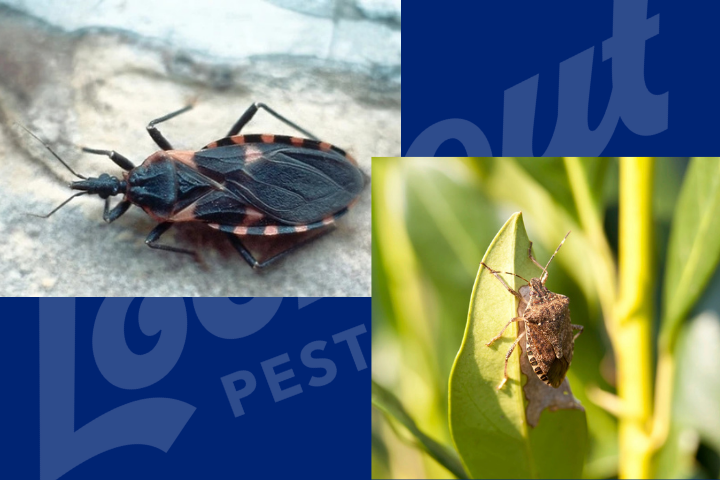
Stink bugs have shield-shaped bodies, eat plants, don’t bite, and release a pungent cilantro-like odor when crushed. Kissing bugs have cone-shaped heads, suck blood at night, can bite humans around the face, and may carry Chagas disease in some regions. The shape of the head and abdomen is the fastest way to tell them apart.
Most people searching stink bug vs kissing bug have just found a dark brown bug in the house and want an answer fast. In most Southeastern homes, that bug is far more likely to be a stink bug than a kissing bug. Even so, it is worth knowing the difference. One is a common, harmless nuisance that wanders indoors during cooler weather. The other is much less common indoors in the Southeast, but it does bite, and it is the insect behind a lot of understandable anxiety online.
Below, you’ll find a quick comparison table, clearer stink bug identification and kissing bug identification cues, what their habits actually are, whether kissing bugs really show up in the Southeast, what else they are often confused with, and what to do next. If you want help confirming what you found, you can schedule a free inspection.
Stink Bug vs Kissing Bug: Quick Comparison Table
Here’s how the two bugs stack up at a glance. Body shape and head shape resolve most cases immediately, even when kissing bug vs stink bug pictures online make everything look more dramatic than it is.
What Does a Stink Bug Look Like?
A stink bug has a broad, shield-shaped body with a distinct triangular plate on the back. For most homeowners, the quickest stink bug identification clues are the wide shield shape, mottled brown coloring, and pale banding on the antennae.
The species most people notice indoors is the brown marmorated stink bug. Adults are usually about 1/2 to 5/8 inch long. Their bodies are wider than many other household bugs, with a flattened, almost armored look. The color is usually mottled brown and gray, sometimes with lighter markings around the edge of the abdomen. One of the best field marks is the light-and-dark banding on the last antennal segments.
Behavior helps too. Stink bugs are plant feeders, not predators and not blood feeders. Outdoors, they feed on fruit, vegetables, soybeans, and ornamentals. Indoors, they are mostly trying to overwinter, which is why they turn up on window frames, ceilings, attics, and sunny walls during cooler months.
Are stink bugs dangerous? No. They do not bite people or pets, they do not sting, and they are not known to spread disease. They are a nuisance pest, not a health threat. Their biggest talents are finding their way indoors and smelling awful if crushed.
What Does a Kissing Bug Look Like?
A kissing bug has a long, flattened body, a pointed cone-shaped head, and a long beak tucked beneath the head. For accurate kissing bug identification, the head shape is the fastest and most reliable clue.
The Eastern species relevant to the Southeast is Triatoma sanguisuga, often called the eastern bloodsucking conenose. Adults are usually larger than a stink bug, around 3/4 to 1 inch long. The body is darker overall, usually brown to black, and the abdomen often shows orange to reddish-orange markings along the outer edge. Unlike a stink bug, the head narrows noticeably toward the front, which gives the insect its “conenose” look.
The mouthparts are also different. A kissing bug has a long, needle-like proboscis that is used for feeding on blood. It folds under the body at rest but is still part of the insect’s overall profile. The legs are longer and thinner than a stink bug’s, and the whole insect looks narrower, flatter, and more predatory.
If you are asking what does a kissing bug look like, think less “shield” and more “long, flat bug with a pointed head and a serious-looking beak.”
Are Kissing Bugs in the Southeast?
Yes, kissing bugs do occur in the Southeastern United States, but they are uncommon indoors. That is the part that often gets lost when fear spreads faster than context.
The species most relevant here, Triatoma sanguisuga, has been documented in Georgia, Tennessee, Alabama, Kentucky, North Carolina, and South Carolina. Even so, most indoor sightings in the Southeast turn out to be something else. Kissing bugs are more often associated with outdoor harborage like woodpiles, animal nests, dog houses, rodent areas, and cracks around outbuildings than with routine indoor infestations.
This is also where the Chagas conversation needs to stay calibrated. Kissing bugs can carry the parasite associated with Chagas disease, but the risk of transmission in the United States is considered low. Most U.S. cases are linked to exposure outside the country, and locally acquired cases are uncommon. That is why the right response is not panic. It is identification.
If you genuinely suspect one in your home, capture it safely if you can, take a clear photo, and get it identified. Most “kissing bug” alarms in the Southeast turn out to be a harmless lookalike.
Other Bugs Often Confused with Kissing Bugs
Several insects get mistaken for kissing bugs because they are dark, flat, and roughly similar in size. Most are harmless or, at worst, unpleasant to handle.
Other assassin bugs are one of the biggest sources of confusion. Kissing bugs are a type of assassin bug, but not all assassin bugs are kissing bugs. Many assassin bugs in the Southeast are predators of other insects, not blood feeders. A wheel bug, for example, can bite if mishandled, but it is not a kissing bug and is not associated with Chagas disease.
Boxelder bugs are another common false alarm. They are dark with reddish lines and gather on sunny walls, but they are plant feeders and a nuisance invader, not a blood feeder. Western conifer seed bugs and leaf-footed bugs also get pulled into the conversation because they are long, dark, and often wander indoors. Bed bugs get mentioned too, but they are much smaller, rounder, and more compact.
So when the question becomes kissing bug vs assassin bug, the answer is that kissing bugs belong to that broader family, but most assassin bugs you might see are not the ones people are worried about.
What Does a Kissing Bug Bite Look Like?
A kissing bug bite usually appears as a small red welt or a cluster of welts, often on exposed skin. The face, especially around the mouth or eyes, is the classic area people associate with it, which is where the common name comes from.
The bite itself may not be noticed right away because kissing bugs tend to feed while the person is asleep. The bump or swelling is often what gets noticed later. Not every suspicious bite near the face is a kissing bug bite, and not every kissing bug bite leads to disease exposure. Transmission requires a separate step involving infected feces near the bite and contact with the wound or mucous membranes.
That distinction matters. A bite alone is not the same thing as infection. If you suspect a kissing bug bite, wash the area thoroughly, save the bug if possible, and talk to a healthcare professional if symptoms like unusual swelling, fever, fatigue, or eye swelling follow.
How to Keep Both Bugs Out of Your Home
The good news is that stink bugs and kissing bugs use many of the same weak points to get indoors. A tighter, better-sealed house makes life harder for both.
- Seal exterior cracks and gaps. Caulk around plumbing penetrations, utility lines, door frames, window frames, and foundation gaps.
- Repair screens and weatherstripping. Torn screens and worn door sweeps are easy entry points.
- Use yellow bug bulbs outside. Night-flying insects, including kissing bugs, are less attracted to them than standard white lights.
- Move wood and debris away from the house. Firewood, leaf piles, and brush give bugs protected harborage.
- Check pet areas. Outdoor pet bedding, kennels, and dog houses can create shelter for kissing bugs.
- Treat the perimeter before seasonal pressure peaks. A preventive exterior treatment is often the smartest move before stink bugs start moving indoors in cooler weather.
This is also where routine service helps. Instead of reacting once bugs are already inside, a preventive approach keeps common invaders from getting comfortable in the first place.
Stink Bug vs. Kissing Bug FAQs
Found a Suspicious Bug? Lookout Can Identify and Treat
Most of the time, the dark brown bug in your house turns out to be a stink bug (harmless, smelly, and seasonal). But if you suspect a kissing bug, it is worth getting the identification right and treating the entry points that let it inside.
Lookout has served the Southeastern US since 1983, with household pest control across Georgia, Tennessee, Alabama, Kentucky, North Carolina, and South Carolina. If you want help confirming what you found, call 706-866-6737, schedule a free inspection, and check the current pest control offer.