

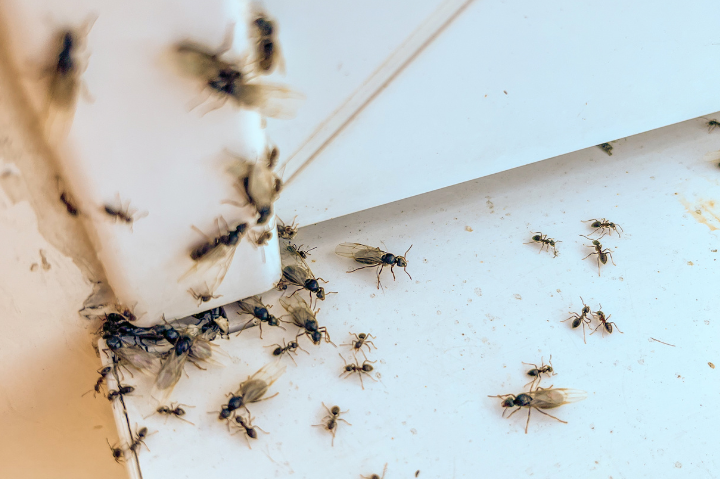
Flying ants can be alarming, especially when they suddenly appear inside your home after a warm, humid day or heavy rain. For many homeowners in the Southeast, they show up all at once around windows, door frames, or ceiling lights, which is why if often feels like an emergency.
In most cases, they are more of a warning sign than a direct threat. A swarm indoors usually means there is already an established colony nearby, so the bigger issue is not the winged ants themselves, but where they are coming from. In this guide, we’ll cover what flying ants are, why they suddenly appear, where they come from, the types you may see, whether they cause damage, how to tell flying ants from termites, and how to get rid of them. If you need help now, Lookout offers professional ant control across the Southeast.
What Are Flying Ants?
Flying ants are not a separate species; they’re regular ants that have reached sexual maturity and grown wings. Pest professionals call them alates, swarmers, or reproductives. Their one job is to leave the colony, mate, and start new colonies somewhere else.
When conditions are right, usually warm, humid weather and often right after rain, mature males and females leave the nest together in what’s called a nuptial flight. That’s why homeowners tend to notice winged ants, or ants with wings in the house, all at once instead of one or two at a time.
After mating, the males die off quickly. Fertilized females shed their wings and go looking for a place to start a new nest. If you find a scatter of shed wings on a windowsill, a floor, or near a light fixture, that’s a sign that a swarm already happened nearby.
One important clarification: “flying ants” and “fire ants” are not the same thing. Fire ants are a distinct species (Solenopsis invicta — the red imported fire ant, common across the Southeast), and only their reproductive members grow wings when it’s time to swarm. Most of the fire ants you encounter in your yard, the ones that sting, are workers, not flying ants.
If you’re already seeing swarms indoors and want fast answers, Lookout has handled ant problems across the Southeast since 1983 and holds a 4.8-star Google rating across 600+ reviews.
Schedule a free inspection and we’ll tell you what you’re actually dealing with.
Why Do Flying Ants Suddenly Appear in My House?
They suddenly appear because the right conditions triggered a nuptial flight, usually warm temperatures, high humidity, and recent rain. If you are seeing them inside, there is a good chance an ant colony is already in or very close to your home.
That is why homeowners often notice them after rain. Rain softens the soil, making it easier for newly mated queens to burrow and start nesting, while the jump in humidity acts as a signal for mature ants to swarm. If they are indoors, there are usually only two explanations: they either flew in through an open door or window, or a mature colony is nesting inside your walls, under your floors, or in a damp area of the house.
They are attracted to moisture, food residue, and light. Leaks, damp wood, bathrooms, kitchens, sugary spills, grease, crumbs, and light sources at night can all draw them in. Seasonal ant activity also increases in warm weather, so it is common to see more ants during summer.
Where Do Flying Ants Come From (And Where Do They Nest)?
They come from established ant colonies, either outdoors or inside the home. When a colony matures, it produces winged reproductives that leave the nest, mate, and start new colonies of their own.
Common nest locations include:
- Outdoors: soil near the foundation, under rocks or patio stones, in rotting stumps, inside mulch beds, behind siding, and in firewood piles stacked against the house
- Indoors: wall voids near plumbing, under sinks, damp crawl spaces, moisture-damaged wood, and above drop ceilings
Bathrooms and kitchens are especially common trouble spots because they provide steady moisture. That is one reason homeowners often search for flying ant infestations in the bathroom after a sudden indoor swarm.
Types of Flying Ants You Might See in the Southeast
There are several types of flying ants in the Southeast, but most homeowners tend to notice the same few. The main differences usually come down to size, color, nesting habits, and whether the ants are simply annoying or capable of causing damage.
Flying Carpenter Ants
These are usually the largest flying ants homeowners see, often black or dark brown with bent antennae and bodies that look more substantial than common house ants. They often nest in moist or decaying wood. Unlike termites, they do not eat wood, but they do tunnel through it to build galleries, which can lead to damage over time. If you see flying carpenter ants indoors in spring or early summer, there may already be a nest inside or very close to the home.
Red Flying Ants (Fire Ants)
Red flying ants are usually reddish-brown and tend to swarm after rain during warm Southern weather. This is one type that can be more than a nuisance, because fire ants can sting painfully when disturbed. If you are dealing with fire ants, it is worth acting quickly.
Flying Black Ants
These are the smaller black or dark brown ants homeowners often see around windows, patios, or garden beds. They usually nest in soil, mulch, or cracks around the property and are generally more annoying than harmful. Because of their size, they are sometimes mistaken for baby ants, but they are actually fully mature adults.
Are They Flying Ants or Termites? Quick ID Guide
Flying ants and termite swarmers look similar, but four quick checks can usually tell them apart. That difference matters because termites can cause serious structural damage, while most flying ants are simply a seasonal nuisance.
Here is the fastest way to compare flying ants vs termites:
- Antennae: flying ants have bent or elbowed antennae, while termites have straight antennae
- Waist: flying ants have a narrow, pinched waist, while termites have a broader body with no clear pinch
- Wings: flying ants have a larger front pair and a smaller back pair, while termites have two pairs of wings that are equal in length
- Color: flying ants are usually brown, black, or reddish, while termites are often pale, creamy, or light brown
If you want a closer breakdown of flying ants vs termites, Lookout has a deeper guide on exactly what to look for. And if you think you may be seeing termite swarmers instead, it is worth taking that seriously right away.
Are Flying Ants Dangerous? Do They Cause Damage or Bite?
For most homeowners, they are a nuisance, not a serious threat. They do not damage homes the way termites do, and most species do not bite or sting. The two main exceptions are flying carpenter ants and flying fire ants.
Most flying ants are harmless if left alone. Carpenter ants can pinch if handled, while fire ants can sting and inject venom, which is painful and may cause stronger reactions in sensitive people.
Flying ants also do not eat wood. However, carpenter ants can still cause damage over time by tunneling through moist or decaying wood to build their nests. A one-time swarm outside is usually not a major issue. But repeated indoor swarms, sawdust-like debris near wood, or large black ants appearing on walls are all good reasons to call a professional.
How to Get Rid of Flying Ants
To get rid of them, start by removing the visible swarm, then close off entry points, reduce what is attracting them, and most importantly, locate and treat the nest. Visible ants are only a small part of the problem. The real issue is the colony producing them.
- Vacuum the visible swarm
A vacuum is the fastest way to clear ants from windows, doors, or light fixtures. Empty the bag or canister outside right away. - Set sticky traps
Place glue boards near windowsills, light sources, and common entry points. They are often drawn to light and will land there. - Remove attractants
Wipe down counters, take out the trash, fix leaks, and store sugary foods or pet food in sealed containers. Moisture and food residue both help attract ants. - Seal entry points
Check weatherstripping, door thresholds, window screens, and gaps around pipes or utility lines. Blocking access helps prevent more ants from getting inside. - Find and treat the nest
This is the step most DIY attempts miss. If you do not eliminate the nest, the swarm may come back. A professional can identify the ant species, trace the activity to the colony, and apply the right treatment.
Recurring swarms, indoor colonies, flying carpenter ants, visible wood damage, or fire ant activity are all good reasons to act quickly. If the problem keeps coming back, schedule a free inspection and let a professional identify what is really going on.